

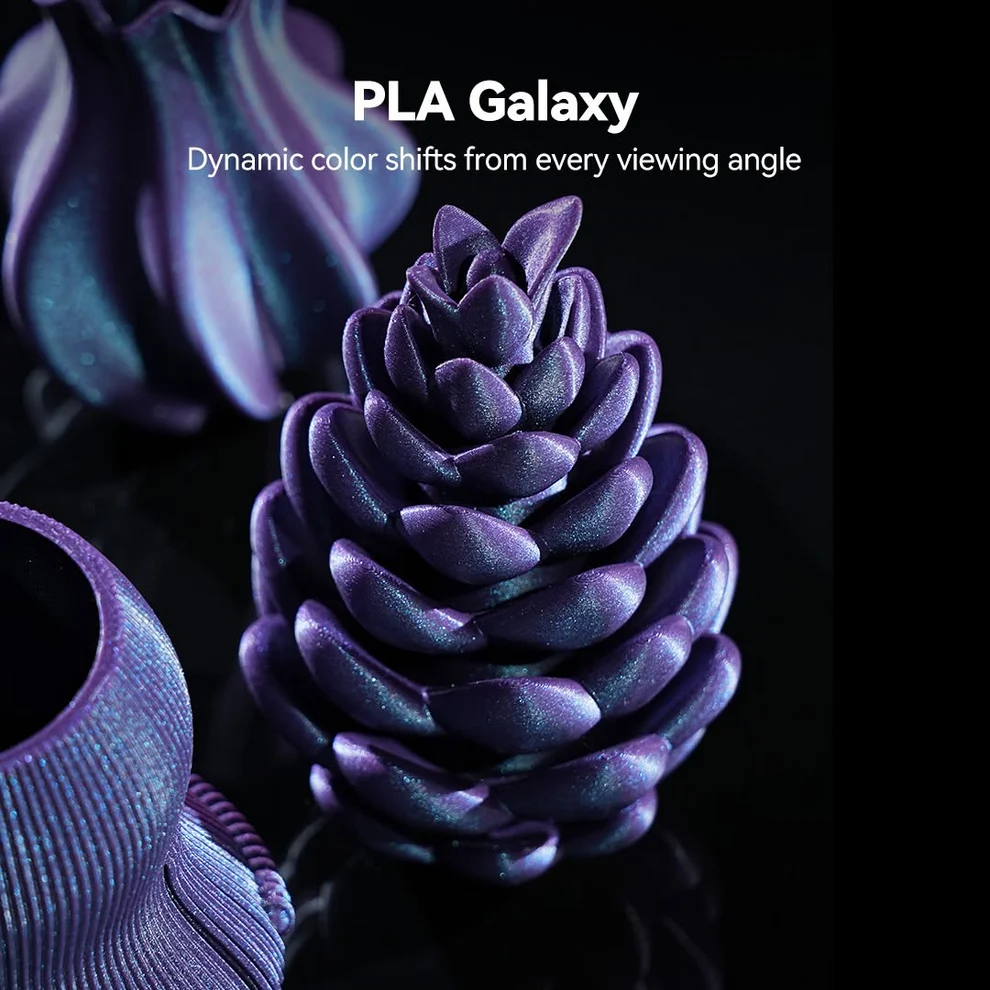
When standard solid-color plastic no longer provides enough visual depth for a display piece, Galaxy Filament offers an alternative with its ultra-fine color-shifting pearlescent powder. Projects that rely on dynamic lighting and changing viewing angles can make good use of this distinctive appearance, as the pearlescent effect changes with the way light interacts with the printed surface. Rather than treating filament as just another building material, makers can consider its visual characteristics when planning a model. The following project concepts demonstrate how to incorporate these color-shifting effects into different designs.
Cosmic Crater Desk Organizers
Designing a desktop organizer with an asteroid or crater-inspired topography maximizes the optical potential of a Galaxy Filament. The concave, irregular walls of a cratered model create varied surfaces that can highlight the color-shifting pearlescent effect under different lighting conditions. Compared with simple flat surfaces, sweeping organic depressions create more varied viewing angles, allowing the pearlescent finish to appear different as the lighting and viewing position change. This geometric interaction transforms a standard desk accessory into a dynamic, eye-catching object.
When slicing these complex shapes, increasing the exterior perimeter walls prevents the darker internal infill from casting shadows beneath the glossy surface. Adjusting the Z-seam to a hidden corner on the base also avoids breaking the visual continuity of the color shift. Furthermore, calibrating the extrusion multiplier helps to maintain consistent extrusion and surface appearance across the printed model. Printing a small calibration cube beforehand helps dial in the flow rate without wasting large amounts of material.
Starlit Geometric Lampshades
A lampshade shifts the material’s function from purely reflective to actively light-diffusing. Printing a lampshade with these sparkling composites creates a projected starlight effect on the surrounding walls. The color-shifting pearlescent finish can create subtle visual variations as light passes through or falls across the lampshade, adding decorative interest to a dark room. It is necessary to use low-heat LED bulbs for this specific project to prevent thermal deformation, as standard PLA has a moderate glass transition temperature.
Printing temperature can affect layer consistency and surface appearance, so users should follow the recommended temperature range for their specific filament and printer. Maintaining a deliberate, steady manufacturing pace rewards operators with smooth walls that transmit light evenly. Finding that thermal balance ensures a consistent finish that catches light from multiple angles, while a slightly thicker wall thickness helps maintain structural stability under the internal heat. Checking the part cooling fan profile is also critical here, as overly aggressive cooling can introduce visible layer artifacts that disrupt the projected light pattern.
Sci-Fi Spaceship Replicas
Detailed spaceship models naturally demand a heavily textured, mechanical aesthetic. The color-shifting pearlescent finish creates visual variation under directional lighting, helping highlight intricate panel lines, engine vents, and rugged planetary surfaces. The layer lines created by the FDM process, which often require extensive sanding on standard plastics, can actually be leveraged as a design feature here. Under directional light, the changing pearlescent appearance can emphasize the model’s surface details, creating a distinctive sci-fi aesthetic without requiring an actual metallic finish.
To maximize this visual effect, carefully plan your model orientation on the virtual build plate. Rotating the model allows the light-catching flakes to align with the most prominent exterior features. Using a quality Filament Galaxy can add visual depth to these intricate builds, although the final structural performance and surface quality still depend on the model design and printing settings. Checking the extruder gear tension also prevents slippage when running these slightly textured materials, ensuring the fine details print without interruption.
Articulated Dragon Fidget Toys
Print-in-place articulated models, such as dragons or fidget toys, present a distinct mechanical challenge. These moving parts require a material that can handle repeated joint movement while still looking visually striking. The color-shifting pearlescent finish adds visual interest to articulated models, making dragons and fidget toys more distinctive as decorative or collectible pieces. However, the suitability of the filament for articulated joints depends on the material’s mechanical properties, joint design, and printing tolerances.
When slicing for print-in-place joints, adjusting the XY contour compensation becomes necessary to ensure the parts do not fuse together. The slight expansion of the polymer as it cools can bind the joints if the tolerances are too tight. Keeping retraction speeds moderate also prevents the textured filament from grinding flat inside the extruder gears, ensuring the articulated joints move freely without binding during the assembly process.
Tabletop Miniature Terrain
Miniature terrain pieces utilize these composites to create atmospheric, immersive environments for tabletop gaming. The color-shifting pearlescent finish adds visual variation to miniature rocks and alien ruins, making ordinary terrain pieces more distinctive under different lighting conditions. Starting with smaller test prints helps calibrate thermal settings before committing to substantial material consumption on massive terrain boards. This cautious prototyping approach helps fine-tune the flow rate, preventing microscopic clogs associated with particulate-infused polymers.
The subtle color-shifting properties mask minor layer lines, making them highly suitable for detailed terrain sculptures that require heavy post-processing on standard plastics. Printing too quickly may affect extrusion consistency and surface quality, so adjusting the print speed to suit the filament and printer can help achieve more uniform results. Maintaining a deliberate and steady pace ensures the prominent features display the intended shimmering effect without compromising the structural details of the terrain. Using a slightly larger nozzle diameter, such as 0.6mm, can reduce print time on these large pieces while still maintaining enough detail for tabletop scale.
Material Calibration and Hardware Longevity
Before starting a large-scale project, check the spool condition, confirm that enough filament is available, and make sure the printer is ready for the planned build. For models with intricate details or moving parts, printing a small test section first can help identify potential issues with clearances, support structures, and overall design. Keeping track of material usage and recording successful slicing profiles also makes it easier to reproduce similar results in future projects.
Sourcing filament from a reputable manufacturer like SUNLU provides makers with a dependable material option for different creative applications. With thoughtful preparation and suitable model designs, Galaxy Filament can add a distinctive pearlescent appearance to decorative objects, collectibles, and display pieces.
