

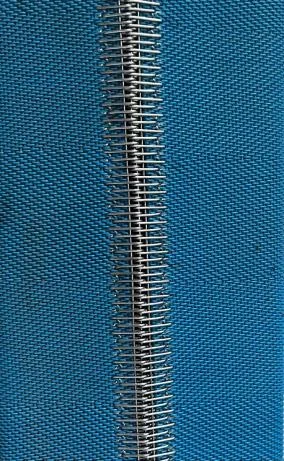
Every mechanical conveyor splice relies fundamentally on the microscopic performance of cold-drawn steel wire. While entire handling systems depend on continuous belt movement, joint reliability depends on whether thin wire segments can withstand cyclic tensile pull without fatiguing.
Understanding how wire hook hardware behaves requires examining wire composition, leg forming, and carcass interaction. Mechanical splices fail when improper wire specifications shear belt cords or deform under high running tension.
Industrial operators increasingly depend on modern conveyor belt lacing to maintain clean splice profiles across package handling, agriculture, and light industrial processing. Exploring the engineering behind wire hook fasteners reveals why wire metallurgy dictates long-term conveyor uptime.
Metallurgical Balance: Tensile Strength Versus Ductility in Fastener Wire
Fastener wire demands an exacting metallurgical compromise that standard industrial wire cannot fulfill. If the carbon steel remains too hard, fastener legs fracture during the aggressive crimping and clinching phases of installation.
Conversely, excessive ductility allows fastener legs to yield and open under continuous operational pull. High-tensile cold-drawn wire strikes this precise balance, offering sufficient malleability to form tight clinch profiles while retaining resilient tensile memory against surging motor loads.
Dynamic conveyor paths continually cycle over small-diameter terminal pulleys, subjecting wire knuckles to millions of reverse-bending stresses. Premium fastener wire exhibits exceptional fatigue endurance, absorbing repeated cyclical deformation without developing internal micro-cracks along the outer radius. Rigorous tensile ratings ensure the wire withstands extreme shock loads without permanent elongation.
Point Geometry and Staggered Penetration Dynamics
Mechanical fastening begins with how wire tips enter the belt carcass. Ground needle points gently push synthetic longitudinal warp cords aside rather than slicing across load-bearing structural fibers. Smooth penetration protects internal carcass integrity against micro-tears that propagate under continuous tension.
Preserving carcass cord continuity ensures that the belt carcass retains maximum rupture resistance around the splice zone. Crushed or severed fabric cords inevitably trigger catastrophic belt tears long before the metal fastener exhibits visible wear.
Engineers integrate a wire hook fastening system featuring alternating long and short leg configurations to disperse mechanical stress across multiple cross-sections. Staggering hook penetration points prevents creating a continuous shear perforation line across the belt width.
Carded solutions developed by Intake demonstrate how double-staggered wire legs lock securely into multi-ply belts. Distributing mechanical grip across staggered planes maximizes carcass retention while minimizing internal ply delamination.
Carded Strip Engineering and Hook Pitch Retention
Individual wire hooks require strict dimensional stability before tool compression occurs. Carded systems bind dozens of individual wire loops onto specialized paper or plastic carrier strips that maintain rigid lateral spacing. Carding paper also acts as a protective shield during transit, preventing delicate hook legs from bending before installation.
Precise pitch retention prevents adjacent hooks from overlapping or splaying during high-speed lacer operations. The carded backing keeps wire teeth strictly parallel, guaranteeing uniform penetration depth across the entire working width of the splice.
Technicians slide the continuous carded strip into mechanical lacer combs to ensure immediate alignment against belt squaring stops. High-grade conveyor belt lacing systems allow the paper carrier to peel away cleanly or disintegrate safely without fouling downstream conveyor components.
Eliminating loose, unlinked hooks reduces installation errors and prevents uneven gap spacing along the hinge line. Uniform hook spacing ensures that every individual wire shares belt tension equally once tensioning counterweights activate.
Clinch Mechanics, Loop Geometry, and Dynamic Tension Transfer
Applying compression force causes fastener legs to fold over and embed flush against the belt cover. Clinching mechanics force pointed wire ends to curve backward into the carcass, creating an internal mechanical lock that resists tensile pullout.
Low-profile wire embedment prevents fastener knuckles from protruding above the belt surface. Sinking wire crowns below the top cover shields the metallic joint from abrasive scraper blades, diverters, and skirt rubber seals.
Properly executed clinches produce uniform loop cavities that accept flexible or rigid hinge connecting pins. Operating an optimized wire hook fastening system preserves true circular loop apertures, eliminating pinched pockets that restrict hinge articulation over snub pulleys.
Tool designers at Intake refine hook forming dies so that each clinched loop matches connecting pin diameters with micrometer precision. Balanced hinge clearances distribute pullout stresses evenly along the full pin length, preventing localized stress risers.
Environmental Alloy Selection for Severe Operating Conditions
Corrosive operating environments rapidly undermine raw steel wire through surface pitting and rust expansion. Galvanized carbon steel wire provides baseline rust inhibition for dry agricultural transport, indoor distribution hubs, and general packaging applications. Standard carbon grades corrode quickly when exposed to moisture or acidic juices, causing rapid wire thinning and unexpected joint separation.
Wet food processing, chemical handling, and coastal logistics demand non-corrosive alloy compositions. Austenitic stainless steel grades, such as AISI 316, provide critical resistance against chlorine washdowns, sanitizing chemicals, and aggressive organic acids.
Selecting matching stainless hinge pins prevents galvanic corrosion cells from forming inside the wire loops. Dissimilar metals exposed to conductive wash water generate electrolytic degradation that corrodes wire contact surfaces within weeks.
Deploying a specialized wire hook fastening system manufactured with premium stainless wire ensures extended joint durability across sanitary environments. Robust chemical resistance prevents premature hook thinning, structural embrittlement, and contamination risks in food-grade sorting lines.
Optimizing Splice Longevity Across Industrial Operations
Long-term conveyor reliability depends on respecting the physical mechanics governing wire hook assemblies. Matching wire gauge, tensile temper, and hook leg length to actual carcass thickness guarantees maximum splice retention under demanding duty cycles.
Regular joint inspection routines should focus on wire hook loop wear, hinge pin straightness, and edge-hook integrity. Addressing deformed loops or missing edge fasteners early prevents progressive joint unzipping across high-speed material handling belts.
Partnering with reputable manufacturers like Intake gives plant engineers access to precision-engineered fasteners and proven splicing methodologies. Specifying high-performance conveyor belt lacing preserves belt investments, stabilizes daily throughput, and minimizes costly emergency downtime across industrial facilities.
