

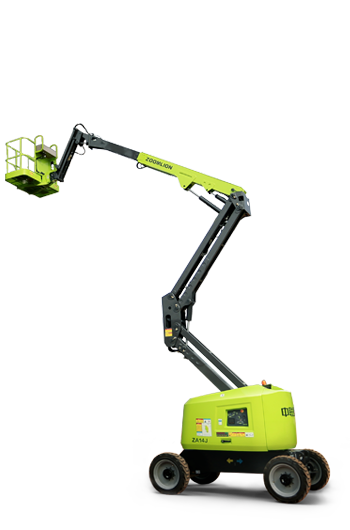
A diesel boom lift can give crews controlled access to elevated steelwork where structural members, connections, cladding, services, and inspection points are spread across an active construction site. Unlike fixed access systems, boom equipment can reposition the platform toward the work face, helping teams handle changing elevations and offsets.
Why Diesel Power Fits Demanding Construction Sites
Steel structure projects often develop outdoors, where machines must travel over uneven surfaces, share space with material-handling equipment, and work through long shifts. Diesel-powered platforms suit these conditions for mobile operation. Choice depends on the site plan, emissions rules, terrain, and access envelope.
A diesel boom lift is useful when workers need elevated access beyond the machine’s footprint. Articulating equipment can move the platform upward and around obstacles, which is valuable when columns, beams, pipework, equipment, or structures interrupt a straight access path. HSE guidance emphasizes selecting the appropriate MEWP and planning its use according to site hazards.
Matching Reach to Steelwork and Industrial Tasks
Working height should not be the only specification considered. For steel construction, procurement teams should compare horizontal outreach, up-and-over capability, platform capacity, machine dimensions, turning radius, ground clearance, and gradeability. These figures determine whether the platform can reach the work point safely.
Platform capacity also matters because crews may carry tools, consumables, inspection equipment, and protective equipment. The rated capacity must include the total permitted platform load. OSHA requires manufacturer-specified boom and basket load limits to be observed, while aerial-lift controls and equipment should be checked before use.
Mobility Around Active Industrial Work Areas
Industrial construction rarely provides an empty work envelope. Structural installation can take place beside foundations, temporary routes, storage areas, access roads, and other trades. A suitable boom lift should therefore be evaluated for turning space, chassis dimensions, ground clearance, and slope capability.
Planning should also account for pedestrians and moving vehicles. HSE recommends separating pedestrians and vehicles and establishing safe traffic routes around MEWP operations. Operator competence, inspection, maintenance, ground conditions, overhead hazards, exclusion zones, and rescue arrangements should be addressed before the machine enters its working position.
Controlling Risk During Elevated Steelwork
Steel erection and industrial maintenance can place personnel close to edges, electrical hazards, structures, and moving equipment. Access planning should define the work position before the lift arrives, including height, outreach, platform load, travel route, and surrounding hazards. This can reduce repositioning and keep the machine within its operating envelope.
OSHA states that only authorized persons should operate covered aerial lifts, boom and basket load limits must not be exceeded, and workers should remain on the basket floor rather than climbing on rails or using ladders for extra height. Daily control checks and proper positioning are also required under the cited construction standard.
How Zoomlion Access Builds the ZA14J for Practical Use
For buyers evaluating a Zoomlion boom lift, the ZA14J provides a concrete example of specification-based job planning. This diesel articulating model has a maximum working height of 15.80 m, platform height of 13.80 m, horizontal outreach of 8.30 m, and up-and-over height of 7.55 m. Its platform capacity is 300 kg.
The ZA14J also has 45% gradeability, equivalent to 24°, with 0.42 m ground clearance and 4WD drive. Its turntable provides 355° non-continuous rotation, while the platform rotates ±90°. Stowed dimensions are 6.57 m long, 2.30 m wide, and 2.27 m high, with a gross weight of 7,100 kg.
The ZA14J from Zoomlion Access uses a Kubota V2403 or Kubota D1105 diesel engine configuration, a 65 L fuel tank, and a 76 L hydraulic tank. The manufacturer lists foam-filled 315/55 D20 tires or 33×12-20 solid tires, depending on configuration. It also lists pressure-control leveling, load sensing, a rotary reducer, and an available hostile kit for dusty environments. These features provide practical reference points when matching machine configuration to demanding worksite conditions.
Why Zoomlion Access Can Be Considered for Access Planning
A Zoomlion boom lift such as the ZA14J can suit projects where elevated work requires vertical access and positioning around obstacles. Its working height, outreach, platform capacity, and articulating configuration give procurement teams concrete parameters for evaluating steelwork, cladding, inspection, installation, and industrial maintenance tasks.
Zoomlion Access states that its portfolio includes more than 100 MEWPs across scissor lifts, telescopic boom lifts, articulating boom lifts, spider lifts, and telehandlers, covering working heights from 6 m to 82 m. It also highlights service support, manuals, training, parts, and global coverage.
Conclusion
Choosing a diesel boom lift for steel structure and industrial construction means matching the machine to the work plan. Reach, capacity, mobility, dimensions, terrain, site traffic, operator requirements, and safety rules should all be reviewed before deployment.
For applications within its specified envelope, the ZA14J gives buyers a concrete model to evaluate. A Zoomlion boom lift can be compared against project height, outreach, ground conditions, and daily operating tasks, while Zoomlion Access provides a broader MEWP portfolio for projects requiring different access configurations.
