

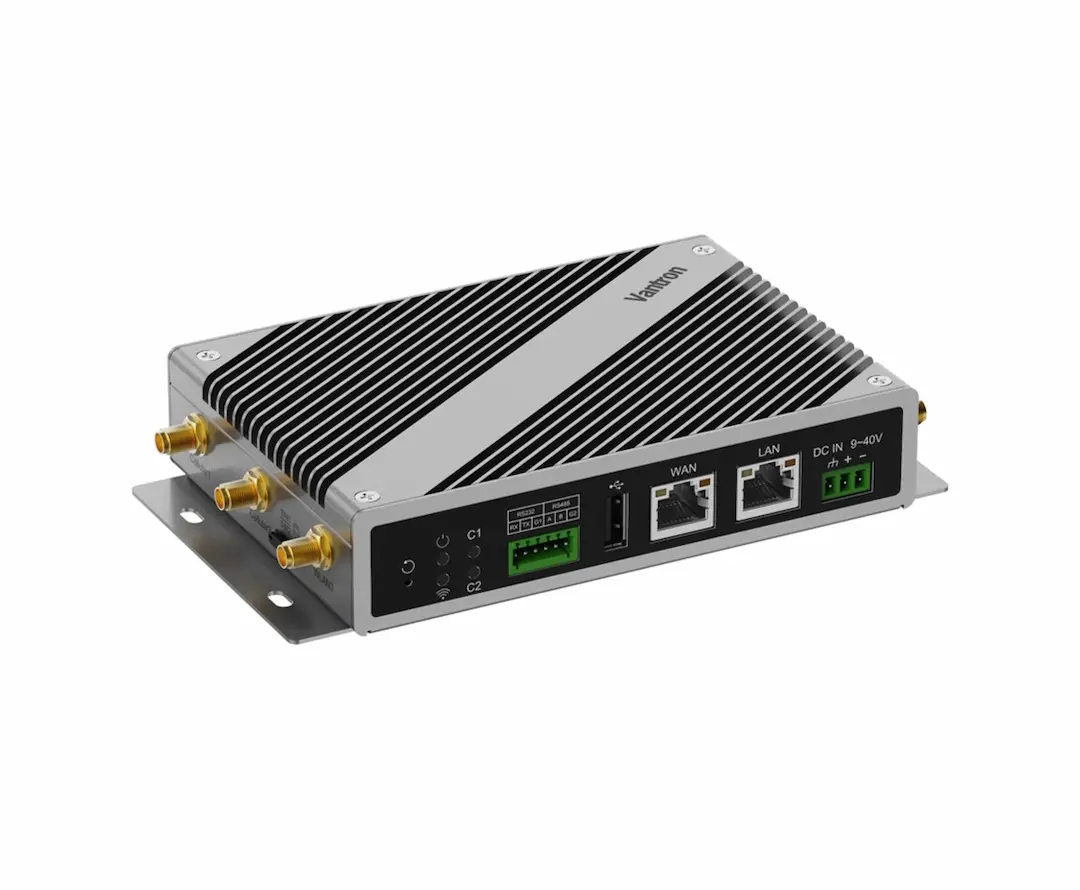
When you evaluate industrial IoT solutions, the hard question is not whether a sensor can connect. It is whether a partner can provide the hardware, software, integration, testing, and manufacturing support needed to connect an embedded device on a machine with usable data, remote operations, and long-term support. Vantron is one example of that edge-to-cloud scope.
For a buyer, the evaluation should cover more than hardware specifications. You need to examine architecture coverage, software integration, connectivity, Edge AI capability, lifecycle planning, compliance support, and the supplier’s ability to respond when equipment is already operating in the field.
What Should an Edge-to-Cloud Partner Actually Deliver?
An edge-to-cloud system has several layers. Sensors and cameras collect data. An embedded computer processes that data near the equipment. Gateways and industrial networks move selected information to higher-level software, while cloud services support monitoring, analytics, and fleet management.
Consider a packaging line that checks labels and counts finished goods. The local computer may need to process images, communicate with a PLC, display alarms, and continue operating if the connection to a central server is interrupted. The cloud can store production records, but the immediate machine response belongs at the edge.
A suitable partner should explain how these layers work together before proposing a product. Ask which device handles inference, where data is stored, how updates are delivered, and what happens after a network interruption. This turns a broad solution discussion into a system design that your engineering and operations teams can review.
Hardware Coverage Should Match the Deployment
A supplier’s hardware range should follow the path of the project. A design may start with a System-on-Module or Computer-on-Module, move to an embedded board with a custom carrier, and later require an industrial box PC, panel PC, gateway, or touchscreen HMI for deployment.
Each form factor addresses a different constraint. A pluggable compute core can support a customized product, while an embedded single board computer may simplify a compact controller. A fanless industrial computer can suit a factory cabinet, and an Edge AI box PC may provide more room for local vision processing. Industrial routers and switches extend the system beyond the computer itself.
Processor choice also depends on software and workload. ARM platforms can suit focused, low-power edge nodes, while x86 can help with existing Windows or Linux applications and peripheral requirements. NXP i.MX8 / i.MX9, Qualcomm, MediaTek Genio, Intel, and Rockchip are platform families that engineers may evaluate for different deployments.
A standard module does not remove the work of designing and validating your own carrier board. You still need to review power, thermal behavior, connectors, I/O timing, enclosure fit, and production testing. A capable partner can support those decisions, but responsibility for the finished system remains shared.
Can the Partner Operate the System After Installation?
Shortlisting IoT solution providers should include a review of post-installation operations. A field device is not finished when it boots for the first time. Your team may need to provision devices, track software versions, monitor connectivity, distribute updates, and recover systems without sending a technician to every site.
BlueSphere covers mobile-device management and gateway-management functions. Its MDM and GWM capabilities support device provisioning, monitoring, and OTA software lifecycle management. Those functions can matter in a fleet of warehouse terminals, medical carts, or remote gateways where inconsistent versions create troubleshooting delays.
Edge processing and cloud management should also have clear boundaries. A vision system may keep raw images and immediate decisions local, while sending selected events and summaries to the cloud. A buyer should ask how logs, access control, update rollback, backup, and network loss are handled. Local inference reduces bandwidth pressure, but it does not remove the need for operational oversight.
Lifecycle and Compliance Belong in the Procurement Review
A supplier’s history can indicate whether it understands long-running embedded programs. Vantron has worked in embedded computing since 2002 and has over 200 research personnel from a variety of fields. For a buyer, the relevant question is how that engineering capacity supports product continuity, issue resolution, and changes across the deployment period.
Compliance planning also needs a specific process. Products are designed to meet FCC, CE, and RoHS requirements, while the company has certification experience involving ISO 13485 for medical applications, IATF 16949 and E-Mark for transportation, and GMS for commercial use. Ask the supplier to map the applicable requirements to the actual product and installation.
Lifecycle support affects more than replacement planning. A stable bill of materials can reduce redesign work, while pre-sales FAE and after-sales support can help resolve interface, operating-system, and integration questions. A review of software ownership, spare strategy, documentation, and escalation paths can expose program risk before volume deployment.
Use a Deployment Scorecard Before You Choose
Build the evaluation around a real site rather than a general catalog comparison. For a factory-floor HMI, review display behavior, cabinet temperature, PLC protocols, service access, and cleaning conditions. For an AGV, review vibration, battery constraints, wireless coverage, sensor interfaces, and recovery after a communication loss.
A practical scorecard can use five gates: hardware fit, software compatibility, edge-to-cloud data flow, lifecycle support, and compliance responsibility. Add the expected AI workload if cameras or local inference are involved.
For projects that require a tailored operating system, interfaces, I/O, enclosure, or logo, Vantron offers OEM/ODM customization and FAE support. Treat that option as one part of the procurement review, alongside representative workload testing, documented update procedures, and a clear owner for every system layer.
