

Rough surface finish is one of the most common quality issues faced by 3D printing users, affecting both visual appearance and functional performance. While problems such as incorrect temperature settings, poor calibration, and unsuitable slicing parameters can influence print quality, moisture-contaminated materials are often an overlooked factor. For businesses relying on consistent production, managing filament conditions is essential to maintaining reliable output.
For professional makers, manufacturers, and service providers, selecting suitable 3D printing consumables and keeping them properly stored can significantly improve print consistency. Among different materials, PLA filament is widely used because of its ease of printing, but even commonly used materials can experience surface defects when exposed to humidity. Filament drying solutions have therefore become an important part of modern 3D printing workflows.
Common Causes Behind Rough Surface Finish on 3D Prints
A rough or uneven print surface can result from several technical factors. One common cause is incorrect extrusion. When the printer does not deliver the right amount of material, the surface may show gaps, inconsistent layers, or visible texture. This issue can often be related to extrusion calibration, nozzle condition, or slicer settings.
Printing temperature also plays an important role. If the temperature is too low, the layers may not bond properly, creating a rough appearance. If it is too high, excessive melting can lead to stringing, surface imperfections, and loss of fine details. Finding the correct temperature range for each material is necessary for achieving smooth finishes.
However, material quality and storage conditions should not be ignored. Many 3D printing consumables are hygroscopic, meaning they can absorb moisture from the surrounding environment. Once filament absorbs water, the moisture may turn into steam during extrusion, causing bubbles, inconsistent flow, rough textures, and reduced layer adhesion.
How Moisture Affects PLA Filament Print Quality
PLA filament is known for its low printing difficulty and broad application range, making it one of the most popular materials in desktop and professional 3D printing. However, PLA filament can still absorb moisture when stored improperly for extended periods.
Moisture-related issues often appear as small surface imperfections, popping sounds during printing, increased stringing, and weaker layer bonding. These problems can become more noticeable when users require smooth cosmetic surfaces or accurate functional parts.
For businesses using 3D printing for prototypes, customized components, or small-batch manufacturing, inconsistent material performance can increase waste and reduce efficiency. Proper filament management, including sealed storage and controlled drying, helps maintain the expected performance of 3D printing consumables.
Drying filament before printing allows absorbed moisture to escape and restores more stable extrusion conditions. This process is especially valuable for materials that require higher temperatures or have greater moisture sensitivity.
Using a Filament Dryer to Improve Surface Quality
A dedicated filament dryer provides a controlled environment to remove moisture from filament before or during printing. Unlike simple storage containers, a dryer actively regulates temperature and helps prepare materials for better printing performance.
SUNLU has introduced several filament drying solutions designed for different user requirements, including the FilaDryer E2, FilaDryer S4, FilaDryer SP2, FilaDryer S4 Pro, FilaDryer S2, and FilaDryer S1 Plus. These models support different filament capacities and workflows, helping users maintain stable material conditions across various applications.
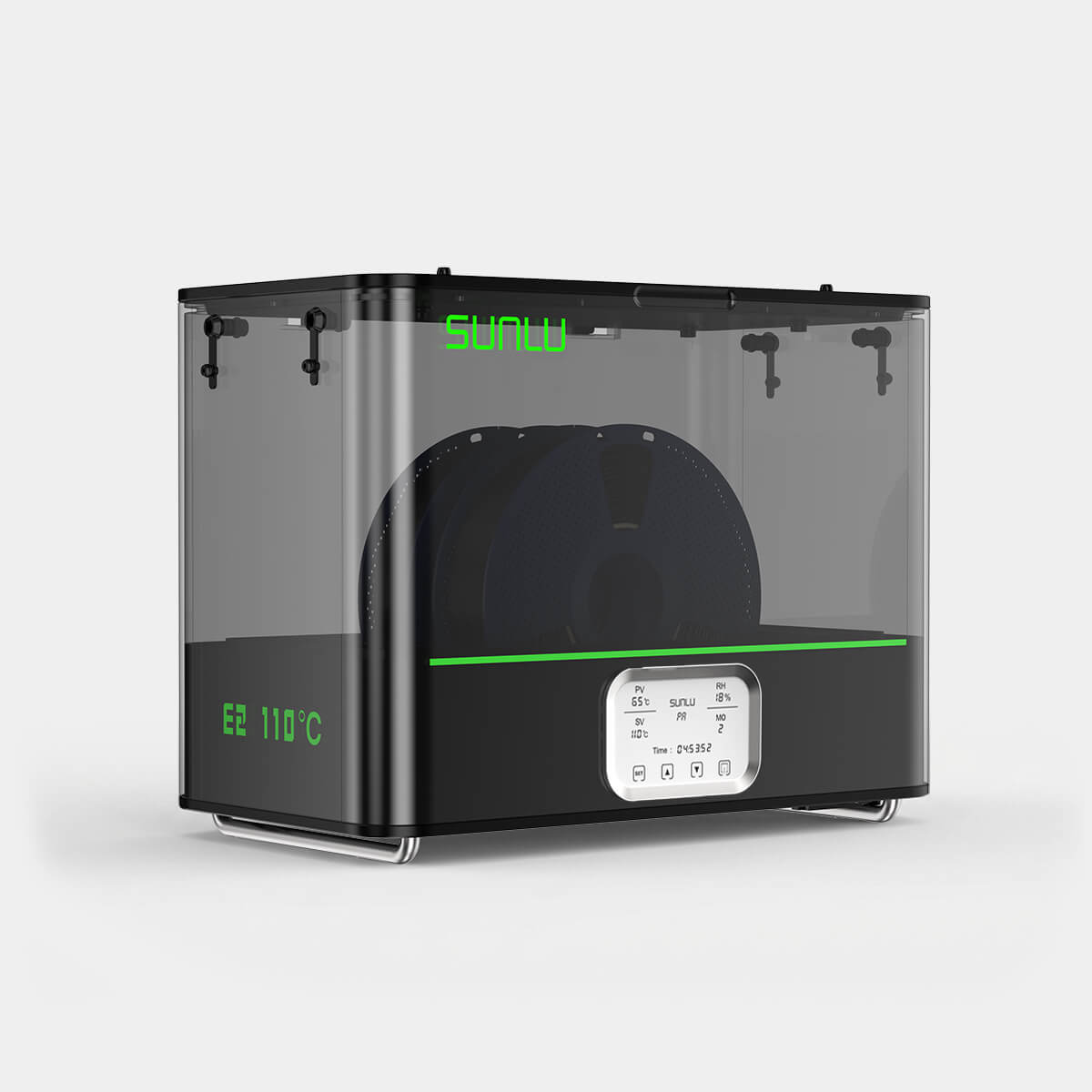
The newly available SUNLU FilaDryer E2 is designed for engineering-grade materials that require more demanding drying conditions. It features a maximum temperature of 110°C, dual drying and annealing functions, and an extra-large capacity. These capabilities make it suitable for moisture-sensitive materials such as PA and PC, helping users prepare advanced materials without compromising their performance.
FilaDryer E2 Supports Drying and Annealing for Advanced Materials
One of the key advantages of the SUNLU FilaDryer E2 is its high-efficiency drying capability. It can rapidly heat up to 70°C for standard filaments and support 90°C for specialty materials such as PA and PC. This helps reduce preparation time while providing a reliable drying environment for both everyday and engineering-grade applications.
Beyond moisture removal, the FilaDryer E2 also provides functional annealing capabilities. It supports 80–90°C annealing for 2–3 hours, helping optimize the material properties of functional filament prints. For users working with performance-oriented materials, this additional function offers more flexibility in preparing parts with specific requirements.
By combining drying and annealing in one device, the FilaDryer E2 helps streamline filament preparation. This is particularly beneficial for companies that depend on consistent results from different types of 3D printing consumables, including standard materials and advanced engineering filaments.
Other Ways to Prevent Rough 3D Printing Surfaces
Although filament drying is important, improving surface finish usually requires a complete printing process approach. Users should also check nozzle cleanliness, print bed leveling, extrusion settings, and cooling parameters.
Proper filament storage after drying is equally important. Keeping materials in a dry environment prevents them from quickly absorbing moisture again. For frequently used PLA filament, regular monitoring and appropriate storage practices can help maintain stable print quality.
Businesses should also select materials according to application needs. While PLA filament works well for many prototypes and visual models, engineering materials may be preferred for parts requiring greater durability, heat resistance, or mechanical performance. Matching the right material with the right preparation method helps achieve better production efficiency.
Building a More Reliable 3D Printing Workflow with SUNLU
Rough surface finish is rarely caused by a single issue. Printer settings, environmental conditions, and filament quality all influence the final result. Among these factors, moisture control is one of the most effective ways to improve consistency, especially when working with different 3D printing consumables.
SUNLU continues to expand its filament management solutions with models designed for various printing scenarios. From compact options for everyday users to advanced solutions like the FilaDryer E2 for engineering-grade materials, these dryers help users maintain better filament conditions and achieve more reliable printing outcomes. For professionals seeking smoother surfaces, fewer failed prints, and improved material performance, integrating a suitable filament dryer into the workflow can be a practical step toward higher-quality 3D printing.
